


Self Employed vs Employed Hairdressers in the UK: The Tax Imbalance Reshaping the Industry
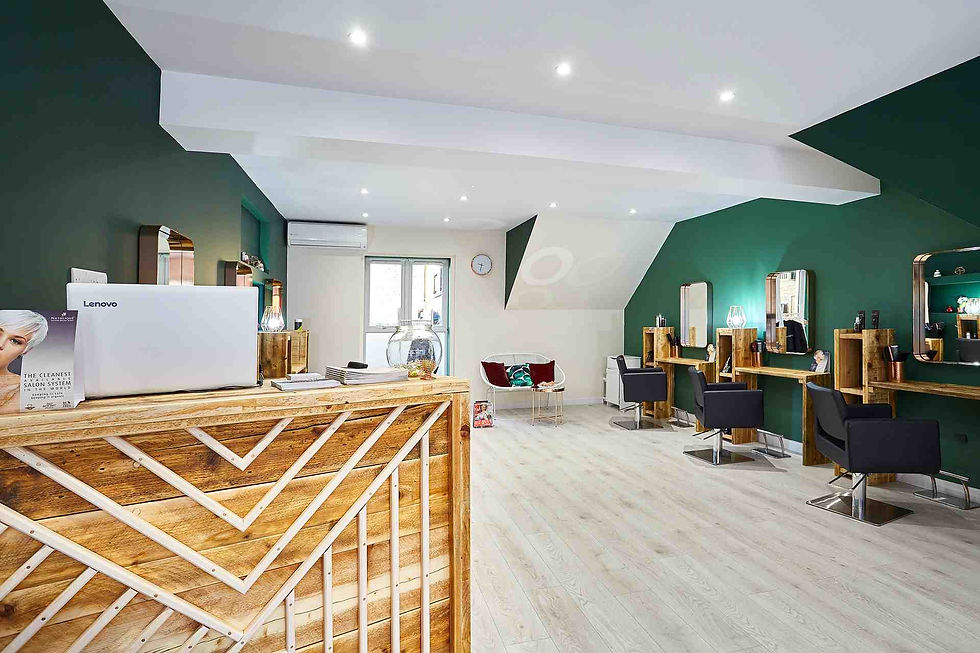
A fully compliant salon that employs its staff and charges VAT faces a combined tax burden far heavier than a neighbouring salon with the same turnover on the same high street that labels its team self-employed instead of employing them.
At the same time, the pipeline of new hairdressers is dramatically collapsing. In England, the number of trainees completing hairdressing apprenticeships fell from 8 660 in 2015 to around 1 520 in 2023, a drop of more than 80%.
Those 2 facts are connected.
Over the past decade, the UK hair and beauty industry has been pushed into a distorted competition where salons that employ, train and comply with the rules are systematically disadvantaged, while models that shift risk onto workers, dodge VAT and blur the line between employment and self-employment are rewarded.
The result is an industry that looks busy from the outside but is increasingly fragile underneath. Prices feel high, margins are wafer thin, apprentices are disappearing, and responsible salons are being priced out by competitors who simply do not play by the same rules.
This article explains what is really happening behind the scenes. It breaks down where your money goes when you sit in the chair, how different salon models radically change who pays tax and who carries risk, and why the long-term cost of cutting corners will be paid by clients, workers and the high street alike.
Table of Contents
A busy industry with fragile foundations
Let us start with the basic picture. NHBF & ONS data for 2023 to 2024 shows that:
revenue is up 6% overall
the number of hair and beauty businesses is still rising, by 4% with about 64,000 of them
the total number of people working in the industry has slightly decreased since 2023, from an estimated 226,557 to 225,490 in 2025
Put simply, the sector is fragmenting. There are more salons and studios operating, but the workforce per business is thinning out, meaning revenue is spread across a growing number of small units with fewer people in each, highlighting the rapid decay of traditional salons.
At the same time, cost pressures have jumped:
national minimum wage and national living wage rises
higher product and energy costs
higher commercial rents in many areas
Straightening out the costs, a recent report for the National Hair and Beauty Federation, estimates that changes in the 2024 Autumn Budget alone added around £139 million in extra annual costs for the sector. Industry analysis suggests that labour accounts for about 60% of typical salon expenses, so rises in the national minimum wage, the national living wage and employer national insurance land very heavily. Surveys now show that roughly one salon in five is trading at a loss. More than 70% expect to raise prices simply to stand still. Many owners have not increased their own income in years.
The latest Budget and business rates: another squeeze on the high street

Alongside rising wages and national insurance, the latest Budget has quietly added fresh pressure through changes to business rates.
For high street businesses, including salons, pubs, cafés and shops, the temporary retail, hospitality and leisure relief that softened the blow of revaluations is being reduced and restructured. In practice, many bricks and mortar businesses are now seeing their rates bills rise sharply, even where turnover has not meaningfully increased.
Trade bodies representing pubs and retailers have warned that:
business rates are once again becoming one of the biggest fixed costs on the high street, hitting physical businesses far harder than online or asset light operators.
This is not abstract: at Margaux Salon, business rates at one of our locations are set to increase by more than 30%, before taking into account any rise in rent, wages or utilities.
Business rates are owed regardless of how busy a salon is, whether chairs are full, or whether a month is profitable. For salons that employ staff and run proper premises, they are a real and unavoidable cost. For looser models that operate on license-style arrangements or fragmented turnover, the exposure can be dramatically lower.
This is the same pressure now facing pubs across the UK, where rising rates combined with higher wages and energy costs have pushed many otherwise viable businesses to the brink. Unlike pubs, salons & other high street businesses, did not get the benefit of targeted relief packages though.
The pattern is consistent across the high street: compliant, people intensive businesses pay more, while lighter models face fewer fixed obligations.
On paper, it looks like a buoyant market. In reality, a very large number of salons are one bad quarter away from real trouble.
For clients, that is why you keep seeing price rises, tighter booking policies and stricter cancellation rules. Most owners are not getting rich. Many have not had a pay rise themselves for years.
How people in salons work now
The biggest change in the industry is not hair trends. It is employment structure.
When you walk into a salon in Britain today, the person who does your hair is probably working under one of three arrangements.
Employed teams
This is the traditional model. The stylist is on payroll. The salon:
pays holiday and sick pay
contributes to a pension
pays employer national insurance
handles tax through PAYE
provides training, insurance and products
It is more expensive for the business, but it gives staff stability and a clear career path. While this used to be the dominant model in UK hairdressing, it now represents only around 40% of the workforce, with the majority operating on a self-employed basis.
Genuine self-employment and rent a chair
In a genuine rent a chair arrangement, the stylist really is running their own business. They:
set their own prices and hours
look after their own clients
take payments directly
pay a chair fee or a share of takings to the salon for the space
They get flexibility and control, but:
no paid holiday
no guaranteed income
no automatic pension
they must manage their own tax, insurance and training
Used properly, this can work. Used badly, it turns into the third category.
The grey zone of disguised employment
In many salons, the reality does not match the label on the contract. You see situations where:
the salon sets the rota and opening hours
prices are set by the salon
everyone must follow the same dress code and brand rules
all client payments go through the salon till
yet staff are told they are self-employed, with no holiday pay or other rights
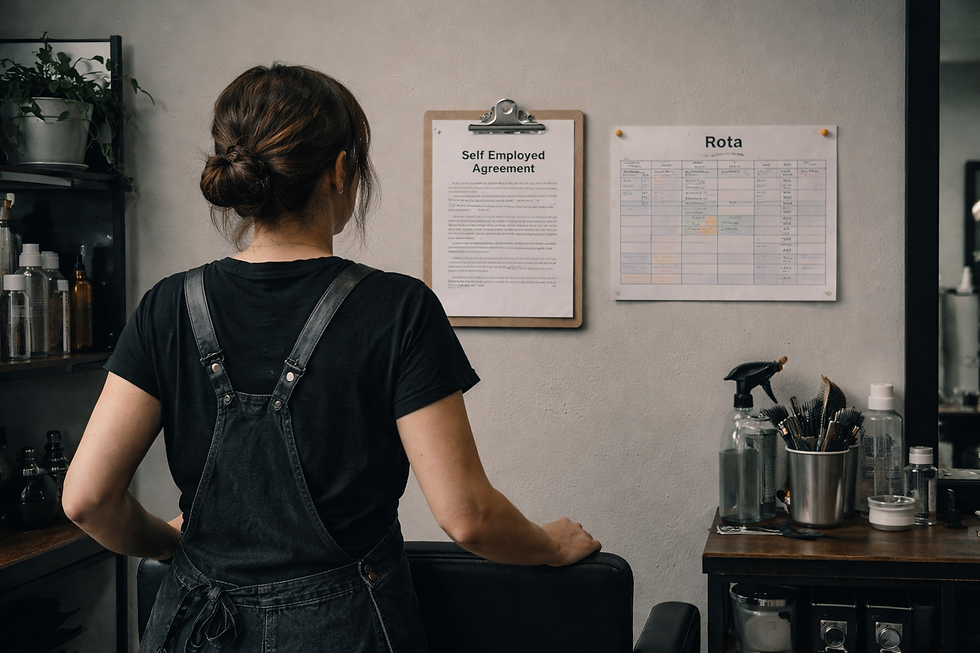
On paper, they are independent. In practice, they look and behave exactly like employees.
HM Revenue and Customs clearly dislike this game. In May 2025 it published sector specific guidance called Check employment status if you work in hair and beauty, explaining common setups and when someone is really an employee for tax purposes.
The guidance gives examples where stylists are labelled as self-employed but have little control. In many of those examples HMRC says they should be classed as employed for tax.
For clients, the important bit is this: if one salon runs a proper payroll with full employment rights and another calls everyone self-employed while controlling everything they do, the second salon will usually be able to charge less. Not because they are better at business, but because they are avoiding costs the first salon chooses to carry.
Why these models are not just different, but unfair
The difference between these models is not just a lifestyle choice or flexibility preference. It is a structural shift in who carries risk, who pays tax, and who funds the future of the trade.
In many grey zone setups, salons operate in a way that mirrors platform models elsewhere in the economy. Control is centralised while risk is pushed onto hairdressers, who often don’t get paid if there’s no clients. Prices, branding, opening hours and client relationships are controlled by the business, while workers are labelled as self-employed and left without paid holiday, pensions or long-term security.
This is not innovation. It is cost avoidance.
As with ride hailing platforms, some salons externalise employment costs onto stylists while retaining the commercial upside. VAT is avoided by staying under thresholds (£90,000 per annum) or fragmenting turnover. Apprenticeships disappear because no single business wants to carry the cost.

Much of this behaviour sits in a grey area that is widely acknowledged but weakly enforced. Like the hand car wash sector, which has long been flagged as unlawful yet remains largely untackled, parts of hair and beauty now operate where rules exist on paper but enforcement is slow and inconsistent.
The result is an unethical competitive imbalance. Salons that follow HMRC guidance, pay VAT, run payrolls and train juniors are undercut by businesses that do not. Over time, this pushes the entire industry away from stable employment, proper training and long-term quality.
What a 100-pound haircut really pays for

To make this concrete, take a haircut that the client is charged £100 for in three different setups: a fully employed VAT registered salon, a genuine self-employed stylist renting a chair under the VAT threshold, and a grey zone arrangement where people are called self-employed but treated as staff while the business stays under the VAT threshold:
In an employed VAT registered salon, that £100 includes £20 of VAT which goes straight to the Treasury, leaving about 80 pounds as sales income. As around 60% of that income goes on wages and associated costs, roughly £45 to £50 goes to staff pay and employer national insurance. On top of that come pension contributions, holiday and sick pay, training time, rent, business rates, software, card fees and product costs. When everything is added up, the true profit left on a £100 bill in a well-run employed salon is often well under £10, even before loan repayments or any owner salary.
For a self-employed stylist who is under the VAT threshold and renting a chair, the same client bill can look very different. There is no VAT to send on, no employer national insurance, and no obligation to provide paid holiday, pension or sick pay. The stylist will pay a chair fee or a share of takings to the salon owner, cover their own tax and training, and fund time off out of their own pocket. The effective tax-take on the client price is much lower and there are fewer protections built into the price for the person doing the work.
In a grey zone arrangement, the business may still avoid VAT by splitting income between entities or by keeping declared turnover below the threshold, while treating people day to day as if they were employees. Prices can then be set closer to the self-employed model while the salon still controls branding, rotas and standards. Some of the money that would otherwise fund VAT, employer national insurance, apprenticeships and proper training instead appears as margin or is used to hold headline prices down to undercut fully compliant competitors.
To illustrate this, when we ran the numbers for our own business, we found that shifting from an employed model to a freelance structure would reduce our tax burden by roughly 12% to 15% of total turnover.
What the Government is now saying about tax and VAT
This is not just industry gossip. Westminster has started to pay attention.
In early 2025, the British Hair Consortium commissioned CBI Economics to review the sector and look at how VAT affects salons. The report is called Securing the future of UK hairdressing and beauty.
A few of the headline points:
hairdressing and beauty are very labour intensive: most of the bill you pay is for people, not products
VAT and employer national insurance hit labour costs harder than they hit goods
salons that employ staff and charge VAT are paying a significantly higher effective tax rate than many other high street businesses with the same turnover
The report also warns that:
According to research for the British Hair Consortium and CBI Economics, the combined impact of VAT and employment taxes can mean that a traditional salon with employed staff is hit roughly three times harder by tax on each pound of turnover than an equivalent independent retail business on the same high street. In simple terms, responsible salons that employ people and pay full VAT are expected to carry a much heavier share of the tax load than rent a chair or non-VAT registered setups with comparable takings.
if nothing changes, employment in traditional salons could fall by more than 90 percent by 2030
apprenticeship numbers could collapse to almost zero in the next few years
Salon owners, stylists and trade bodies have taken this to Westminster. There have been protests outside Parliament and debates where MPs pressed the Treasury to cut VAT on labour for salons, or at least look again at how the system treats highly labour intensive services.
The skills squeeze

Now we come to something that directly affects every client: skills and training.
Hairdressing has always relied on apprenticeships. It is how most good stylists start.
The numbers are grim. Guardian analysis of Department for Education data shows that in England the number of trainees enrolling in hairdressing apprenticeships fell from around 13 180 in 2015 to about 4 160 in 2023. The number actually completing their training dropped from 8 660 to around 1 520 in the same period.
Every time a salon chooses not to hire apprentices because the numbers do not stack up, the pipeline shrinks. If almost everyone does this for long enough, the industry will be left with far fewer qualified stylists, more rushed informal learning on the floor, and a real possibility that in a generation there simply will not be enough experienced professionals to meet demand.
Some press reports now warn that if current trends continue, there could be almost no apprentice hairdressers left within a few years.
For clients, this means:
fewer highly trained colourists and cutters in five to ten years
longer waits to see the senior stylists who do exist
more unstructured learning on the job instead of proper technical training
Discount apps and booking platforms

Another structural pressure comes from discounted online booking marketplaces such as Fresha, Treatwell and Booksy.
Their models differ in detail, but the economics are broadly similar. A platform charges a high one-off commission on the first visit it says it has generated, often in the region of 20% to 35% of the full-service price. On top of that sit card processing fees on online payments, sometimes subscription fees for the software, and optional paid visibility tools such as Boost style features that effectively function as marketing commission.
The commission is calculated on the total booking value, not on the net income the salon actually keeps. That means VAT registered salons are paying platform commission on VAT collected on behalf of the Government. When introductory discounts are layered in to compete within the app, the pressure intensifies. Commission is taken on the discounted price, payment fees are added, and the business still carries wages, rent, utilities and employment costs in full. By the time the first visit is complete, a significant portion of the headline price has already left the salon.
The structure is similar to travel platforms such as Booking.com, where percentage-based commissions became embedded as a standard cost of distribution for hotels. The difference is that hairdressing is highly labour intensive and margin sensitive. When a large share of the first transaction, and a smaller but persistent slice of follow up payments, is diverted through platform economics, it quietly compresses profitability across the sector. For many independent salons, this has become another material factor shaping pricing, staffing and long-term sustainability.
None of this means platforms are evil. Used carefully, they can help new businesses get seen and give clients convenience. The problem comes when a salon becomes dependent on them and starts building its model around very low headline prices supported by discounts and commission-based marketing.
The human side of all this

Strip away the jargon and we end up with people.
Stylists, colourists and therapists do much more than provide a technical service. They listen to you. They remember your big work presentation, your wedding, your health worries. They juggle emotional labour on top of physical work. They stand for hours. They inhale chemicals. They absorb stress that is not their own.
Academic work on emotional labour in personal service professions shows higher risks of burnout and stress, especially when pay is low and job security is weak.
The Director of Labour Market Enforcement repeatedly highlights:
insecure work and disguised employment as priority areas, precisely because of the human cost for workers and their families.
In practical terms, a stylist who is truly self-employed with a strong client base and proper pricing can be fine. A stylist who is called self-employed but treated like staff, with no safety net and no pension, is in a very vulnerable position.
When you sit in the chair, you are sitting across from a person with rent or a mortgage to pay, perhaps children to feed, and no guarantee of income if they get injured or ill. The model their salon uses makes a huge difference to how secure that life is.
What responsible salons do differently

So what does “doing it properly” actually mean? Here is what it looks like for salons like ours.
We employ our teams
That means contracts, PAYE tax, employer national insurance, pension contributions, paid holiday and sick pay. We carry the legal responsibility for the working environment and health and safety.
We pay full VAT and business taxes
Our prices fully include VAT. We do not use artificial structures or split entities to duck under the threshold. We accept that as a service business that relies heavily on people, our tax bill will be higher than that of many other businesses with the same turnover.
We invest in training
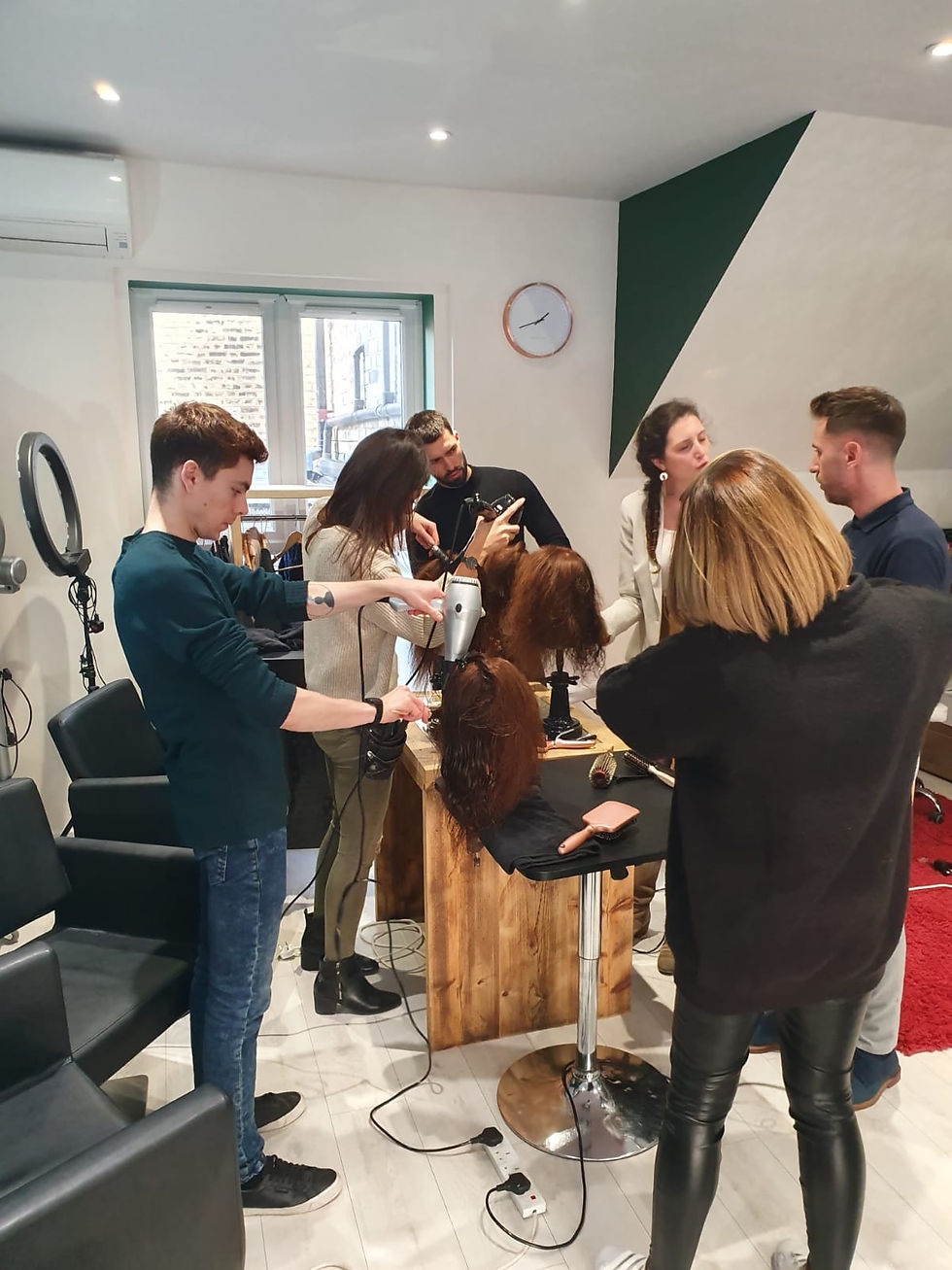
We take on junior hairdressers where we can and we build training time into our costs. That includes colour education, technical skills, consultation skills and safety. We do this knowing that juniors may move on later. It is part of our responsibility to the craft.
We use technology carefully
We use online booking tools for convenience, but we do not build our model on deep discount marketplace offers that depend on high commissions and voucher culture. We want relationships with clients that last years, not one-off bargain hunters who never come back.
We are honest about status
If someone works for us, they know whether they are employed or genuinely self-employed. We deliberately avoid the kind of grey zone arrangements HMRC is now warning against. If anything, we err on the side of giving more security, not less.
Your visit as a moral and collective choice
For you as a client, the key question is:
if a cut or colour is only viable when the stylist is unpaid for part of their time, the business dodges VAT, or large commissions are swallowed in silence, is that really the kind of model you want to support?
The total amount of tax needed to fund schools, hospitals and public services does not shrink just because some businesses find ways to reduce their contribution. If fully employed, VAT paying salons disappear, that money has to come from somewhere else:
from other types of business that cannot avoid the burden
from higher taxes on individuals
or from cuts in public services
At the same time, if apprenticeships continue to decline and more of the workforce moves into fragmented, isolated work, the overall skill level in hairdressing will fall. That means fewer highly trained stylists, less innovation, and more risk for clients.
This is why salons like ours are becoming rarer. It is also why they matter.
When you choose to visit one of our salons, you are not only buying a cut or colour in a pleasant space. You are choosing to support:
fair employment for the people who work on your hair
real investment in training and apprenticeships
a business that pays its full share of tax into the system we all rely on
It is a small act with a surprisingly wide impact. It keeps a skilled, tax honest part of the industry alive. It helps ensure there will still be well trained stylists in ten years.
It quietly backs the idea that doing things properly should not be a disadvantage.
So next time you book with us, know this:
You are doing something good for yourself, because you get care, craft and continuity.
You are doing something good for the people who look after you.
And, in a modest but very real way, you are doing something good for everyone else too.


最近替家裡的新成員想名字,偶然看到這個 起名網,內容整理得很完整,也提供不少命名方向,值得慢慢參考。
I have observed that the variables are consistently addressed in a proportional manner. The terminology continues to be precise. Supplementary contextual information regarding this subject can be acquired by visiting the website. Digital entertainment ecosystems broaden the purview of analysis.