


Finding your first grey hair at 25: what it means and what to do next

Finding your first grey hair at 25 can feel oddly personal, especially when it appears upright at the parting under unforgiving bathroom light. The reassuring answer is that one grey hair, or even a small scattering, usually does not mean anything is wrong or tell you how quickly the rest will follow.
Greying is mainly influenced by genetics and age, although health, smoking and stress may affect the timing for some people. Here is what we know, what remains uncertain, and what you can sensibly do next.
Quick answers
Is one grey hair at 25 normal?
Yes. Finding a first grey hair at 25 is often a normal variation, especially if parents or siblings also went grey young. The age at which greying starts varies widely between families and ethnic backgrounds.
Does one grey hair mean I will be fully grey soon?
No. One hair cannot predict the pace of future greying. You may see very little change for years, or notice more gradually around the temples and parting.
What are the main premature greying causes?
Family history is the clearest clue. Studies also report associations with smoking and, in some people, vitamin B12 deficiency or thyroid conditions, but a grey hair alone does not diagnose any of these.
Should you pluck grey hairs?
No. Plucking one does not make several grow back, but repeated plucking can irritate the follicle and contribute to thinning, and the replacement hair will usually still be grey.
Can grey hair in your 20s turn dark again?
Usually it remains grey, although rare natural repigmentation has been documented. There is no reliable supplement, shampoo or treatment that restores genetically grey hair.
When should I speak to a GP?
Arrange a GP appointment if greying increases quickly or comes with symptoms such as unusual tiredness, breathlessness, numbness, feeling cold, weight change, hair loss or new white patches on the skin.
Table of contents
Your first grey hair at 25 is a clue, not a diagnosis

Dermatology papers often define premature greying as before 20 for Caucasian people, before 25 for Asian people and before 30 for Black people. These broad categories are imperfect and are not a medical diagnosis. At 25, context matters more than the label.
Look at your family first. Research consistently links early silver strands with family history. A single strand does not mean you are ageing unusually fast, and it gives no timetable for what happens next.
It is worth taking a clear photo of your parting in daylight and then leaving it alone for three months. That gives you a much better sense of pace than checking every morning, when the same few hairs can look more obvious depending on where your parting falls.
What changes inside the follicle
Hair receives its colour from melanin made in the follicle. As pigment production falls, new hair grows with less colour or none. The visible shaft is already formed, so a brown length does not simply turn grey overnight.
Some grey strands feel wirier, drier or more resistant to colour, although not every grey hair is coarse. Conditioner through the lengths and heat protection may help roughness, but neither will put pigment back.
Genes set the pace, with a few possible influences

Genetics remains the most useful explanation for grey hair in your 20s. Premature greying causes are still being studied, and most research shows associations rather than simple proof that one factor caused the change.
Smoking has been linked with earlier greying in observational studies, although that does not mean every smoker goes grey early or that stopping will recolour existing strands. There are many better established health reasons to stop, and a pharmacist or GP can help if you want support.
Stress deserves a measured answer. A Nature study found that acute stress could deplete pigment stem cells in mice. A small human study later mapped greying alongside psychological stress and found rare examples of pigment returning. This does not prove that a difficult month caused your grey hair, and reducing stress is not a dependable colour treatment.
Research has reported links with vitamin B12 deficiency and thyroid conditions in some groups, but evidence is mixed and does not support taking supplements just in case. Correcting a genuine deficiency matters for your health. Taking extra when you are not deficient is unlikely to change genetically grey hair.
The point where a health check makes sense
One or two strands with no other symptoms can usually be watched at home. Speak to a GP if the change is rapid or extensive, especially without a family pattern, or if it arrives with persistent tiredness, breathlessness, pins and needles, feeling unusually cold, weight change, dry skin, hair loss or heavy periods. Those symptoms can have many causes, but they are reasons to ask whether tests for vitamin B12, folate, iron or thyroid function are appropriate.
Also seek advice if a clearly defined patch of hair turns white alongside pale or white skin, as pigment conditions such as vitiligo can affect both. A pharmacist can help with general questions, while a GP or dermatologist is the right person for diagnosis. A salon cannot diagnose a deficiency or thyroid condition from your hair.
Plucking, trimming and leaving it alone

The old claim that several grey hairs grow in place of one plucked strand is a myth. Each follicle grows its own hair. The less useful truth is that the same follicle will generally produce another grey strand, while repeated pulling can irritate or damage it and may contribute to thinning.
If one upright strand bothers you, change the parting, smooth it with a small amount of styling cream, or carefully trim the visible length without cutting nearby hairs. Leaving it alone is also completely reasonable. Grey hair is not damaged hair simply because it lacks pigment.
Choosing whether to cover, soften or keep it
There is no need to colour one strand. If more arrive, the right option depends on contrast, placement, hair condition, budget and how often you are genuinely willing to return.
A temporary root powder or mascara can hide a few strands until the next shampoo, though rain, gym sessions and touching the hair can make it less reliable.
A demi permanent colour can soften early grey and usually fades more gently than permanent coverage. It may not make every resistant white hair completely opaque, which is often helpful if you want a blended result without a hard regrowth line. Expect the effect to change over roughly six to eight weeks, depending on washing, porosity and shade.
Permanent colour gives stronger coverage but creates a clearer line as the hair grows. Once regrowth becomes noticeable, many clients choose appointments around every four to six weeks. That is a real diary and budget commitment, particularly if your natural colour is dark and the grey is concentrated around the hairline.
Fine highlights or lowlights can break up the contrast rather than cover every strand. They often allow eight to twelve weeks between larger appointments, but must be planned around previous box dye, dryness and hair strength. Ask for a clear quote and timing before committing. A first colour visit may also require an allergy alert test in advance.
A realistic first year plan

Imagine a 27 year old client with dark brown, wavy hair and about twelve silver strands around her parting. She washes after three weekly gym sessions and knows that a four week root appointment will not fit her budget or diary.
For the first three months, she photographs the same parting once a month and uses a wash out root product only for occasions. If the number stays similar, she may do nothing. If the contrast starts to bother her, a demi permanent blend every six to eight weeks is one option. A few carefully placed highlights with longer gaps between appointments could also soften the area, but only if her condition and old colour history make lightening sensible.
The useful decision is not whether grey is good or bad. It is whether the result still feels like her, and whether the upkeep works on an ordinary wet Tuesday rather than only on appointment day.
London water changes texture, not pigment
North London hard water can leave mineral deposits that make hair feel dull, rough or harder to manage. It does not switch off pigment in a follicle or cause a brown strand to grow grey. If your hair feels coated, try a clarifying or chelating wash occasionally, perhaps every two to four weeks to begin with, followed by conditioner. Adjust the frequency if your scalp is sensitive or your hair is porous, lightened or very dry.
For day to day care, condition the lengths, protect hair before heat styling and keep tool temperatures moderate. This can help grey and pigmented strands sit together smoothly, but no shampoo can restore missing melanin.
A calm colour conversation at Margaux Salon
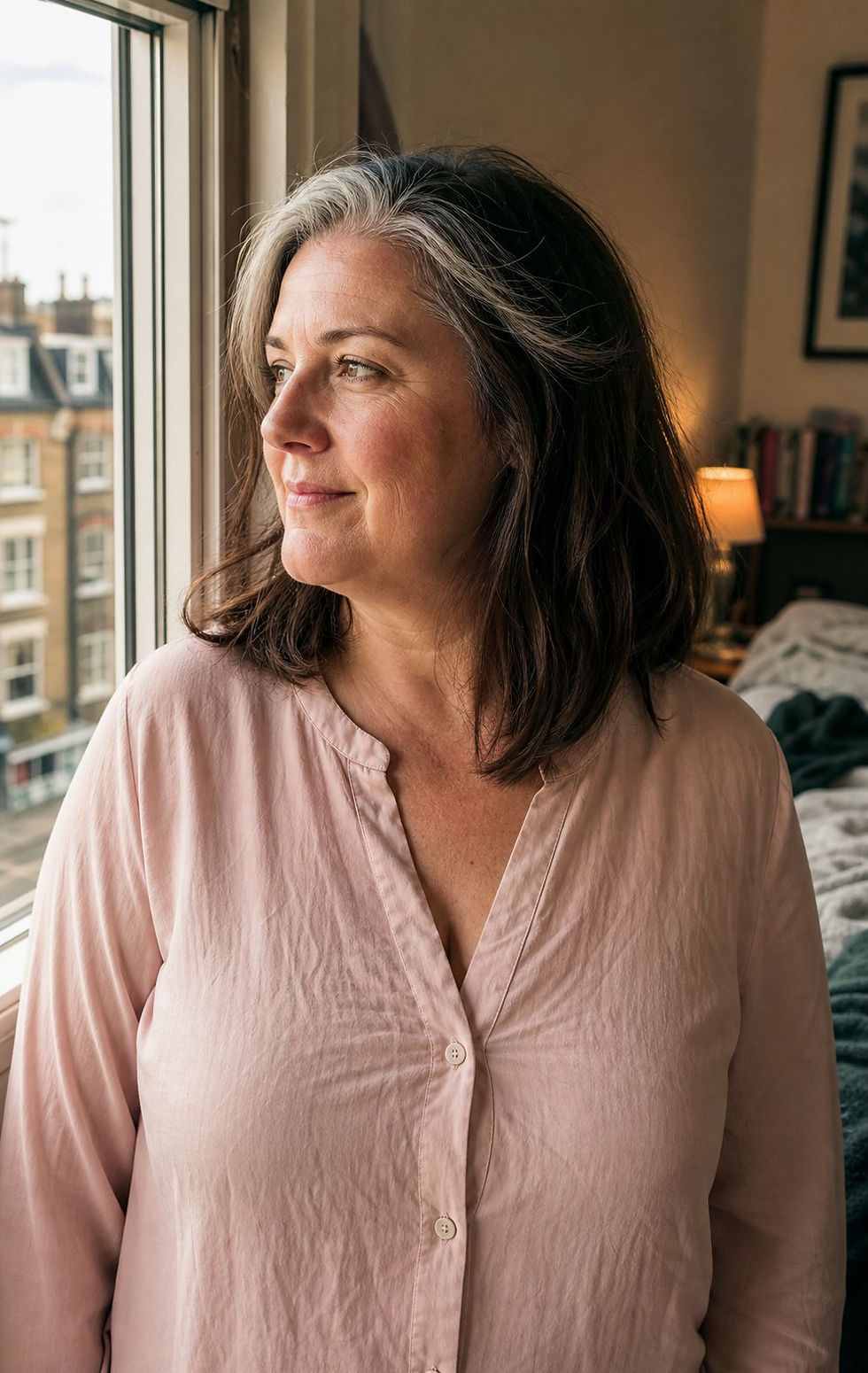
Margaux Salon can help if you want to understand your blending and coverage options without being pushed into a full colour routine. Our teams in Kentish Town, Highbury and West Hampstead start with hair history, condition, the result you want and the upkeep you can live with. We use natural and sustainable products chosen for performance, with allergy testing where required, and healthy hair remains the priority.
Book a consultation at your nearest Margaux Salon if you would like a clear plan before deciding whether to colour at all.
Conclusion
Your first grey hair at 25 is usually a small sign of how that individual follicle is producing pigment, not a warning that something is wrong. Check the family pattern, watch the pace for a few months and speak to a GP if other symptoms appear. Whether you keep it, soften it or cover it, choose the option whose upkeep suits your real week. There is no deadline to decide.
Sources
American Academy of Dermatology: What causes gray hair, and can I stop it?
Indian Dermatology Online Journal: Premature Graying of Hair: A Comprehensive Review and Recent Insights
International Journal of Trichology: Premature Graying of Hair: Review with Updates
Journal of the American Academy of Dermatology: Association of premature hair graying with family history, smoking, and obesity
International Journal of Trichology: Serum vitamin B12, ferritin and thyroid function in premature canities
Nature: Hyperactivation of sympathetic nerves drives depletion of melanocyte stem cells
eLife: Quantitative mapping of human hair greying and reversal in relation to life stress
NHS: Underactive thyroid
NHS: Vitiligo
NHS: Hair dye reactions


Comments